Aircraft: C172 N13205
Flight Time: 1.2 hours
Total Hours: 39.2
After flying less than perfect patters at Birchwood the other day, I felt I needed more practice landing at non-towered airports where I don’t have familiar visual cues to guide me along my downwind, base and final legs. Goose Bay, a 3,000 unpaved runway on the other side of the Knik Arm seemed like a good choice, since I’d never been there before. Plus, it would be a chance to get in some genuine soft field takeoff and landing practice on a real Alaskan gravel strip.

We took ‘205’ today, since it has the bigger tires and flew a few miles north after crossing the channel until the strip came into sight. It was certainly different than anything I’d done yet, being right up against the water on the south and surrounded by trees on all sides. I entered the pattern, announced myself on the common traffic frequency and began my descent for runway 25. I was a little low and far out over the water on my base leg, and Mark pointed out that if the engine were to fail, we wouldn’t have enough altitude to glide back to land. I made a mental note to fly a tighter pattern next time.

It was exciting to come in over the trees and make my first gravel touch down, and although I came in pretty fast and ate up a couple hundred feet of the runway, I got the plane down pretty smoothy and kept it straight as we slowed down. We came to a full stop on the first landing and then after we took off again, we did 6 more touch and gos. My patterns got much more precise as I went on. I really concentrated on being consistent with the power and trim wheel during my descents and eventually was able to get my airspeed under control on final so that I wouldn’t float too much during my flare. One thing that threw me off a bit was that ‘205’ indicates airspeed in MPH instead of knots. I haven’t flown this plane in quite awhile, and so that difference might have made thing a bit more challenging.
The thing I had I struggled with today was getting the nose up enough during the flare. I kept landing somewhat flat, which is exactly what you don’t want to do on a soft field landing. Fortunately, the strip was in pretty good shape, but this is an area where I need work. Overall, my landings today were pretty smooth and straight, I just need to refine my flare.
I felt that I accomplished the two things that I wanted to improve on today, which were to fly a more consistent pattern and to make sure I was not swerving on the runway after I had landed. I’ve been having trouble with that, and I think it’s because as the plane slows down, the rudder control loses effectiveness and that’s the time it’s most prone to veering left. The amount of control input that’s needed to keep the plane tracking straight on the centerline of the runway during final quickly changes and I haven’t been compensating for that. Today, I made sure to increase my control input on the rudder once we were on the ground and slowing down each time.
Once back at Merrill, Mark and I talked about my progress and went over the numbers in my logbook. At this point, I have met all of my other requirements and only have less than one hour to reach the required 40 hours of training. Although I feel good about my skills at the point, and know that I just need a little bit of work on my landings, I asked Mark what he thought.
He agreed with me about the landings, and thinks that we can knock those into shape with one more dual lesson. Other than that, he feels that my flying skills are up to par, and since I scored a 90% on my written exam, I obviously have a solid knowledge on the material. His assessment is that I’m ready for my checkride!
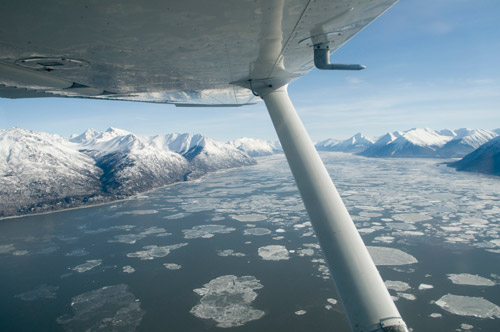 The air was incredibly smooth over the Turnagain Arm, much calmer than the two times I’d flown over it. I turned at the HOPER checkpoint, and then when I passed over the mouth of the Chikaloon River bay, I turned south to a heading of 182°. I checked my stopwatch as I passed over each of my checkpoints and noted that I was pretty much right on with my estimated groundspeed and times.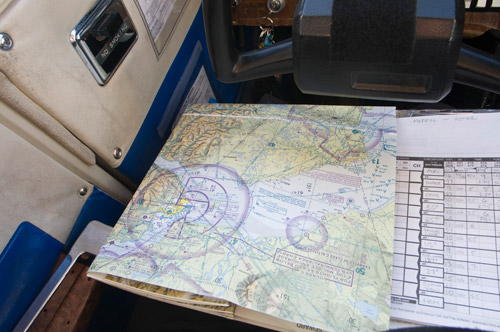
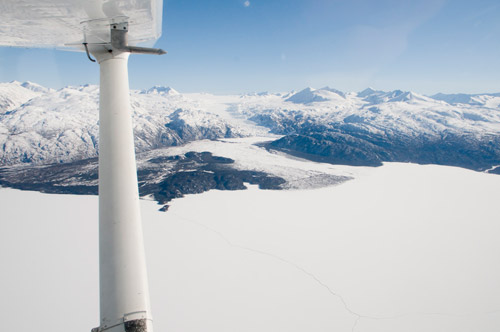 I tried hard to maintain steady altitude as I flew, especially during the times when I looked down at my map. Having always liked maps and the process of navigation, I find it incredibly enjoyable to navigate by sectional as I fly over the terrain and try to identify my location by identifying features on the ground below me. I’m also fascinated by the seemingly simple process of VOR navigation, and although it’s quickly being replaced by GPS as the desired method of route finding, I find comfort in those needles and radio codes.
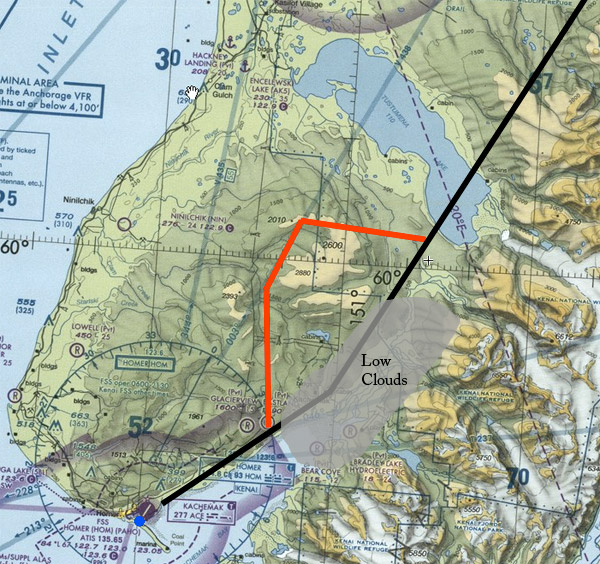 Since I didn’t want to end up stuck above the clouds near Homer, I changed course and began heading straight west, hoping to pick up the 003° radial from the Homer VOR. I called FSS on the radio and amended my flight plan.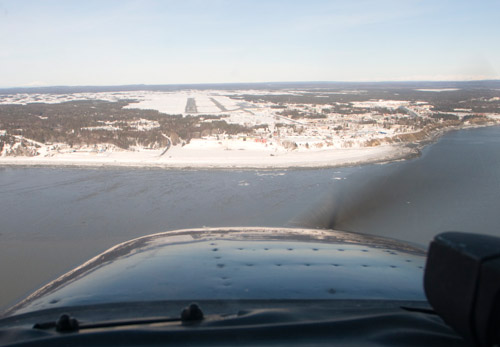
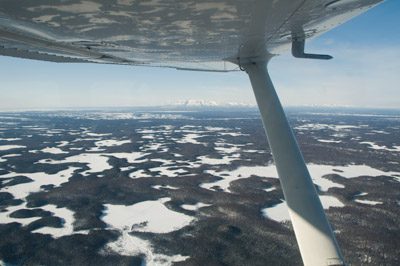
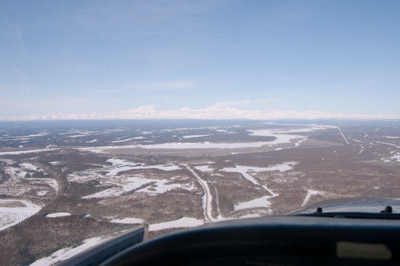 After flying over the Big Lake VOR, I turned to track the outbound 330° radial. Soon, I flew over the Willow airport and veered closer to the large, braided Susitna River. To the Northwest, I could see the three big mountains, Denali, Foraker and Hunter. I didn’t see any other planes, but along the way, I tuned into the common frequency to monitor traffic over the surrounding airports.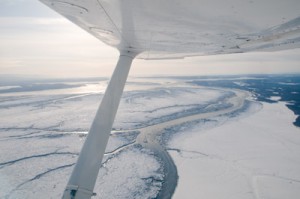
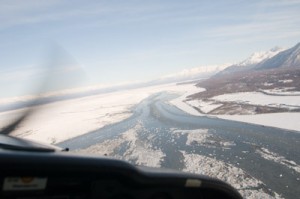 I came back around and did two touch and go’s. My pattern could have been better, but my landings were not bad. Climbing out after the second one, I veered left to get on other side of the Glen Highway and headed back to Anchorage.